

Sustainable Aviation Fuel Market Projected to Reach USD 17.01 Billion by 2035, Growing at 25.2% CAGR
Sustainable Aviation Fuel Market
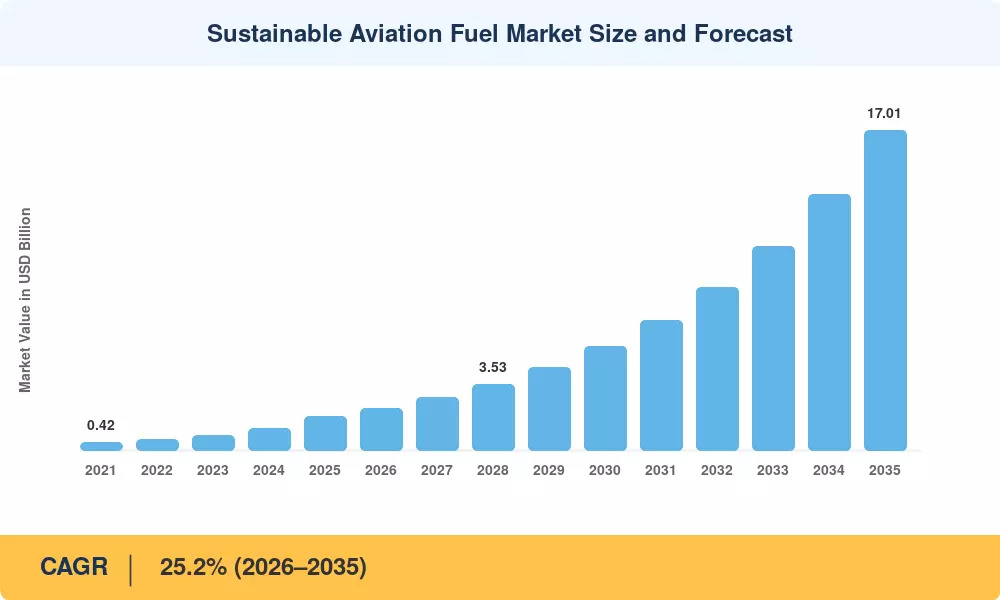
Sustainable Aviation Fuel Market to register a CAGR of 25.2% to reach USD 17.01 Billion during 2026 to 2035
As Per the MRFR Analysis, Sustainable Aviation Fuel Market to register a CAGR of 25.2% to reach USD 17.01 Billion during 2026 to 2035.”
NEW YORK, NY, UNITED STATES, August 24, 2026 /EINPresswire.com/ -- As Per the MRFR Analysis, Sustainable Aviation Fuel Market to register a CAGR of 25.2% to reach USD 17.01 Billion during 2026 to 2035. sustainable aviation fuels market analysis by industry size, share, revenue, regions, top Companies, sales, demands, regions, trends and forecast till 2035.— Prashant Hake
Market Overview
The Sustainable Aviation Fuel Market is undergoing a transformative expansion, driven by the convergence of stringent regulatory mandates, airline net-zero commitments, and technological advancements in production pathways. Sustainable Aviation Fuel (SAF) represents a drop-in replacement for conventional jet fuel, produced from sustainable feedstocks such as used cooking oil, animal fats, agricultural residues, and municipal solid waste, offering lifecycle greenhouse gas emissions reductions of up to 85% compared to fossil-based kerosene [1][5].
Two catalysts are reshaping this trajectory: the European Union's ReFuelEU Aviation regulation, which mandates minimum SAF blending ratios starting at 2% in 2025 and escalating to 70% by 2050, and the U.S. Inflation Reduction Act's SAF tax credit of up to USD 1.75 per gallon for fuels achieving at least a 50% lifecycle emissions reduction [1][2]. These policy instruments have transformed SAF from a niche environmental product into a compliance-driven commodity with binding demand visibility through 2035.
A fundamental technology transition is underway. Conventional petroleum-derived jet fuel faces displacement by hydroprocessed esters and fatty acids (HEFA) pathways, gasification-based Fischer-Tropsch (FT) synthesis, alcohol-to-jet (AtJ), and emerging power-to-liquid (PtL) electrochemical routes [3]. Global airlines committed over USD 35 billion in SAF offtake agreements between 2022 and 2025, signaling that demand-side pull has shifted from voluntary pledges to binding procurement contracts [4][8].
The demand outlook for the Sustainable Aviation Fuel Market remains exceptionally strong. North America commands approximately 38% of the market, anchored by refinery conversions in the U.S. Gulf Coast and West Coast corridors. Europe holds roughly 34% share, driven by regulatory certainty from the EU Emissions Trading System's aviation scope expansion. Asia-Pacific is the fastest-growing region with an estimated CAGR of 29.5%, propelled by Japan's Green Transformation bonds and India's draft SAF policy [1][6].
By 2030, the Sustainable Aviation Fuel Market will likely see production capacity exceed 10 million metric tons per year as new biorefineries and power-to-liquid facilities reach commercial scale [5][6]. This rapid scaling trajectory positions SAF as the primary decarbonization lever for the aviation industry, which accounts for approximately 2-3% of global CO₂ emissions and faces limited alternative propulsion options for long-haul routes.
Get Free Sample Report for Detailed Market Insights:
https://www.marketresearchfuture.com/sample_request/11965
Market Segmentation
By Production Technology
The Sustainable Aviation Fuel Market is segmented into HEFA (Hydroprocessed Esters and Fatty Acids), Fischer-Tropsch (FT), Alcohol-to-Jet (AtJ), Power-to-Liquid (PtL), and Others (DSHC, Co-Processing). HEFA pathways account for approximately 62% of the market in 2025, reflecting mature refining infrastructure and feedstock availability [7]. Used cooking oil and animal fats are the primary feedstocks, with producers like Neste, World Energy, and Phillips 66 collectively building over 2 million tonnes of annual HEFA-SAF capacity [3].
Fischer-Tropsch synthesis is growing at a CAGR of roughly 31.4% through 2035, driven by municipal solid waste gasification projects and waste diversion mandates [9]. Power-to-liquid routes, while holding the smallest share today, attracted over USD 4.2 billion in announced project investments between 2023 and 2025, offering near-complete lifecycle decarbonization through the combination of green hydrogen and captured CO₂ [12]. Alcohol-to-jet technology, leveraging ethanol feedstock abundance in Brazil and the U.S., represents a growing segment with significant scale-up potential [24].
By Feedstock
The market serves Used Cooking Oil (UCO), Animal Fats & Tallow, Agricultural Residues, Municipal Solid Waste, and Algae & Other Novel Feedstocks. UCO dominates with 45% share in 2025, benefiting from low cost and established collection networks [13]. However, global UCO collection volumes are estimated at 6–8 million metric tons annually, while combined demand from all renewable fuel pathways could exceed 15 million metric tons by 2028, driving feedstock price inflation of 15–25% year-over-year [22].
Municipal solid waste represents the fastest-growing feedstock segment at a CAGR of 34.6%, offering a dual opportunity: diverting waste from landfills while producing SAF from a feedstock with negative or near-zero cost [9]. Agricultural residues and algae-based feedstocks are gaining traction as cellulosic conversion technology advances and sustainability requirements for waste-derived fuels intensify [5].
By End User
The Sustainable Aviation Fuel Market serves Commercial Aviation, Military Aviation, Business/Private Aviation, and Cargo/Freight Aviation. Commercial aviation represents USD 1.30 billion in 2025 demand, the largest application segment, driven by CORSIA compliance and airline net-zero pledges [4]. Over 130 airlines—collectively responsible for 65% of global revenue passenger kilometers—have published net-zero by 2050 strategies identifying SAF as the primary decarbonization lever [18].
Military aviation programs, including the U.S. Department of Defense's operational energy strategy, are expanding SAF procurement at an estimated CAGR of 28.3%, driven by energy security mandates and operational resilience requirements [4]. Business and private aviation, supported by corporate ESG commitments, and cargo/freight aviation, driven by e-commerce logistics decarbonization pressure, represent smaller but rapidly growing segments.
By Region
North America leads the Sustainable Aviation Fuel Market with a 38% share in 2025, underpinned by production tax credits and refinery conversion investments [2][3]. Europe holds a 34% share, driven by ReFuelEU mandates, EU ETS revenue recycling, and PtL investment [1]. Asia-Pacific is set to exceed USD 4.8 billion by 2035, driven by national decarbonization roadmaps across Japan, South Korea, and India [10][24]. South America and the Middle East & Africa represent smaller but strategically important markets, leveraging sugarcane ethanol infrastructure and green hydrogen investments for power-to-liquid production respectively [12].
You can buy this market report at:
https://www.marketresearchfuture.com/checkout?currency=one_user-USD&report_id=11965
Regional Analysis
North America
North America commands approximately 38% of the Sustainable Aviation Fuel Market, anchored by refinery conversions in the U.S. Gulf Coast and West Coast corridors. The United States dominates regional demand, accounting for 88% of regional share, driven by the Inflation Reduction Act's SAF tax credits (USD 1.25–1.75 per gallon), the DOE's SAF Grand Challenge targeting 3 billion gallons by 2030, and refinery conversion economics that leverage idled petroleum infrastructure [2][17]. Phillips 66's Rodeo facility in California—the world's largest renewable fuels refinery with 50,000 barrels per day capacity—achieved full conversion at roughly 40% of greenfield cost [3]. Canada's Clean Fuel Regulations and SAF consortium partnerships support a 27.1% CAGR through 2035 [22].
Europe
Europe holds roughly 34% share of the Sustainable Aviation Fuel Market, driven by regulatory certainty from the EU Emissions Trading System's aviation scope expansion and the world's most comprehensive regulatory architecture. ReFuelEU Aviation creates binding demand with a 2% volumetric mandate in 2025, ratcheting to 6% by 2030, 34% by 2040, and 70% by 2050 [1]. Germany leads with 24% of regional share, supported by a national PtL roadmap targeting 200,000 tonnes of synthetic kerosene by 2030 [12]. France and the UK follow with significant biorefinery investments and SAF mandate implementation from 2025 respectively [15]. The EU ETS generates carbon price signals exceeding EUR 65 per tonne that improve SAF's relative economics [1].
Asia-Pacific
Asia-Pacific is the fastest-growing region in the Sustainable Aviation Fuel Market, driven by Japan's Green Transformation (GX) bonds, India's draft SAF policy, and expanding airport hub infrastructure. Japan accounts for 32% of regional share, with its USD 150 billion GX bond program allocating significant funding to SAF production infrastructure [10]. India's aviation sector—the world's third-largest by domestic passengers—has drafted SAF blending targets that would create a market exceeding USD 1 billion annually by 2032 [24]. Singapore's position as Asia's premier jet fuel trading hub makes it a natural aggregation and distribution node for regional SAF supply [4].
Rest of the World
South America, Middle East & Africa, and other regions represent approximately 6% of the Sustainable Aviation Fuel Market but offer strategic growth opportunities. Brazil dominates South American demand with 78% of regional share, leveraging its established sugarcane ethanol industry for alcohol-to-jet production [24]. The Middle East's market trajectory is anchored by massive green hydrogen investments, with the UAE's Masdar committing over USD 5 billion to projects that could supply synthetic kerosene to Dubai and Abu Dhabi's hub airports [12]. Saudi Arabia's NEOM project envisions an integrated green hydrogen-to-e-fuel value chain powered by 4+ GW of dedicated solar and wind capacity.
Competitive Landscape / Key Players
The Sustainable Aviation Fuel Market exhibits moderate concentration, with the top five producers accounting for an estimated 45–50% of global output. Key players include Neste, World Energy, Phillips 66, TotalEnergies, Gevo, LanzaJet, Fulcrum BioEnergy, SkyNRG, Velocys, and Twelve [14].
Neste leads with an estimated 14–18% revenue share, offering HEFA-SAF from UCO and animal fats with vertically integrated feedstock-to-fuel operations as the largest global SAF producer [3]. World Energy follows with 8–11% share, operating the first dedicated SAF refinery in Paramount, California, and offering SAF blending services [7]. Phillips 66 holds 7–10% share, leveraging the largest single-site renewable fuels refinery globally at its Rodeo facility [19]. TotalEnergies commands 5–8% share, with European production leadership and integrated energy major capabilities [15]. Gevo holds 3–5% share, pioneering the alcohol-to-jet pathway with its proprietary isobutanol technology and Net-Zero 1 project secured with a USD 1.63 billion conditional DOE loan guarantee [17].
Strategic developments in the industry include the European Commission's September 2024 publication of implementing rules for ReFuelEU Aviation, finalizing monitoring, reporting, and verification protocols for SAF blending compliance at EU airports effective January 2025 [1]. Gevo secured a USD 1.63 billion conditional DOE loan guarantee for its Net-Zero 1 facility in South Dakota in July 2024, targeting 65 million gallons per year of SAF [17]. ICAO adopted the 2050 Long-Term Aspirational Goal for net-zero CO₂ emissions from international aviation in October 2023, reinforcing CORSIA as the primary market-based mechanism [11].
Latest Industry News & Developments
European Commission (September 2024): Published implementing rules for ReFuelEU Aviation, finalizing monitoring, reporting, and verification protocols for SAF blending compliance at EU airports effective January 2025 [1].
Gevo (July 2024): Secured USD 1.63 billion in conditional DOE loan guarantee for its Net-Zero 1 facility in South Dakota, targeting 65 million gallons per year of SAF and other renewable hydrocarbons [17].
ICAO (October 2023): Adopted the 2050 Long-Term Aspirational Goal for net-zero CO₂ emissions from international aviation, reinforcing CORSIA as the primary market-based mechanism [11].
Neste (June 2023): Completed expansion of its Singapore refinery to 1.3 million tonnes per year of renewable product capacity, with approximately 30% allocated to SAF production for Asia-Pacific customers [10].
Japanese Government (April 2023): Announced a target of replacing 10% of jet fuel consumption at Japanese airports with SAF by 2030, backed by GX bond financing [10].
Market Challenges & Opportunities
Challenges
The Sustainable Aviation Fuel Market faces several notable challenges. The SAF cost premium over conventional jet fuel—currently trading at 2–4 times the price—represents the most significant restraint, with HEFA-based SAF carrying a premium of USD 1,500–3,000 per metric ton depending on pathway and feedstock [20]. BloombergNEF projects the premium will narrow to 1.5–2x by 2030 as production scales, but near-term margin compression remains a drag on adoption velocity [21].
Feedstock availability and competition with road biofuels pose another constraint, with UCO facing intense competition from renewable diesel producers serving road transport mandates [13][22]. Blend wall limitations under current ASTM standards—which approve SAF blending at up to 50% by volume—restrict total displacement potential even at airports with abundant supply [14]. Infrastructure gaps at secondary and regional airports, and certification lead times for novel pathways (typically 5–7 years from lab demonstration to commercial approval), further challenge market growth.
Opportunities
Significant opportunities exist in the Sustainable Aviation Fuel Market. Power-to-liquid scale-up in renewable-rich geographies—Patagonia, the Middle East, North Africa, and Scandinavia—offers a pathway that avoids feedstock constraints facing lipid-based routes, with projects like Haru Oni in Chile and Norsk e-Fuel's Mosjøen plant in Norway targeting production costs below USD 2,000 per metric ton by 2030 [12]. Waste-to-jet pathways using municipal solid waste offer virtually unlimited feedstock potential if gasification economics continue improving, with Fulcrum BioEnergy's Sierra BioFuels plant demonstrating commercial viability [9][23].
Emerging market SAF adoption through CORSIA compliance creates greenfield opportunities for technology licensors and feedstock aggregators in developing nations [11][24]. Book-and-claim SAF accounting and digital certification platforms unlock demand from airlines operating at airports without SAF supply infrastructure, potentially adding 15–20% incremental demand above physical supply constraints [25]. Corporate travel SAF programs and Scope 3 reporting frameworks (CDP, TCFD, CSRD) create a parallel demand channel independent of airline procurement, with companies like Microsoft signing multi-year SAF procurement deals exceeding USD 50 million [4].
To explore more market insights, visit us at:
https://www.marketresearchfuture.com/reports/sustainable-aviation-fuel-market-11965
Final Market Summary
The Sustainable Aviation Fuel Market is poised for exceptional growth, projected to expand from USD 2.25 billion in 2026 to USD 17.01 billion by 2035, at a remarkable CAGR of 25.2%. This expansion is fundamentally underpinned by regulatory blending mandates, production tax credits and subsidies, and airline net-zero commitments that have shifted demand from voluntary pledges to binding procurement contracts. North America maintains its dominant position, while Asia-Pacific emerges as the fastest-growing region, driven by national decarbonization roadmaps and strategic investments in production infrastructure. Technological innovation, including pathway diversification toward Fischer-Tropsch, alcohol-to-jet, and power-to-liquid routes, is reshaping the competitive landscape, enabling operators to address feedstock constraints and achieve near-complete lifecycle decarbonization. The market's long-term potential remains exceptionally strong, supported by the convergence of regulatory certainty, corporate ESG commitments, and emerging opportunities in waste-to-jet pathways and corporate travel SAF programs, ensuring sustainable aviation fuel's critical role as the primary decarbonization lever for the aviation industry through 2035 and beyond.
More Related Reports from MRFR Library:
Biodiesel Market: https://www.marketresearchfuture.com/reports/biodiesel-market-1521
Managed Pressure Drilling Market: https://www.marketresearchfuture.com/reports/managed-pressure-drilling-market-1586
Biomass Power Market: https://www.marketresearchfuture.com/reports/biomass-power-market-1692
Coiled Tubing Market: https://www.marketresearchfuture.com/reports/coiled-tubing-market-1738
Power Transmission Cables Market: https://www.marketresearchfuture.com/reports/power-transmission-cables-market-1768
Oil & Gas Separators Market: https://www.marketresearchfuture.com/reports/oil-gas-separator-market-1809
Industrial Air Compressor Market: https://www.marketresearchfuture.com/reports/industrial-air-compressor-market-2075
String Inverter Market: https://www.marketresearchfuture.com/reports/string-inverter-market-2083
Concentrated Solar Power Market: https://www.marketresearchfuture.com/reports/concentrating-solar-power-market-2104
Electric Motor Market: https://www.marketresearchfuture.com/reports/electric-motors-market-2376
Larry Wilson
WantStats Research And Media Pvt. Ltd.
+ +1 855-661-4441
email us here
Visit us on social media:
LinkedIn
Facebook
YouTube
X
Legal Disclaimer:
EIN Presswire provides this news content "as is" without warranty of any kind. We do not accept any responsibility or liability for the accuracy, content, images, videos, licenses, completeness, legality, or reliability of the information contained in this article. If you have any complaints or copyright issues related to this article, kindly contact the author above.
