

Aviation IoT Market to Reach US$ 84.56 Billion by 2035, as Smart Airports and Connected Aviation Drive 20.5% CAGR
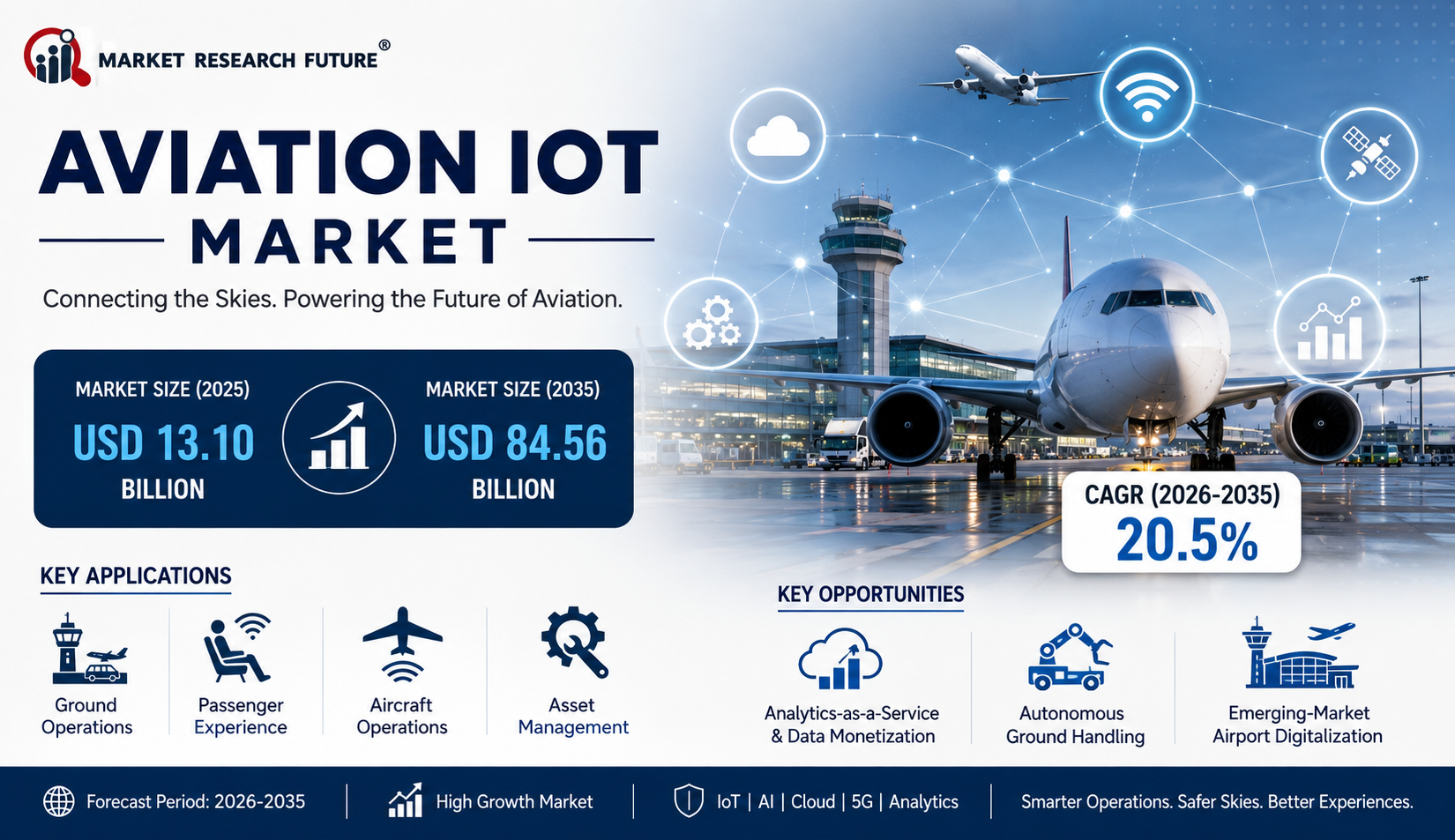
Aviation IoT Market
Aviation IoT Market Size projected to reach USD 84.56 Billion by 2035, expanding at a remarkable CAGR of 20.5% during 2026–2035.
NEW YORK, NY, UNITED STATES, July 14, 2026 /EINPresswire.com/ -- The Aviation IoT Market is entering a transformative growth phase as airlines, airports, aircraft manufacturers, and maintenance providers increasingly adopt connected technologies to improve operational efficiency, passenger satisfaction, and safety.The aviation sector is rapidly evolving from isolated digital systems to interconnected ecosystems where aircraft, airport infrastructure, passengers, baggage, and maintenance operations continuously exchange real-time data. Internet of Things (IoT) technologies are enabling aviation organizations to optimize fleet utilization, automate airport processes, strengthen predictive maintenance capabilities, improve air traffic coordination, and deliver highly personalized passenger experiences.
Increasing investments in smart airport initiatives, deployment of private 5G networks, adoption of satellite-based connectivity, and growing implementation of artificial intelligence and edge computing are creating unprecedented opportunities for Aviation IoT solution providers worldwide. Furthermore, governments and aviation authorities are promoting digital modernization through air traffic management programs, sustainability initiatives, and regulatory frameworks that encourage connected aviation infrastructure.
Request Sample of Report: https://www.marketresearchfuture.com/sample_request/6873
Latest Aviation IoT Market Trends:
• Rapid Expansion of Smart Airport Ecosystems
Airports across developed and emerging economies are investing significantly in digital infrastructure to manage increasing passenger volumes. Smart airport technologies include connected terminals, automated baggage systems, intelligent security screening, smart lighting, environmental monitoring, and AI-enabled operational control centers.
IoT devices provide continuous visibility into airport assets, allowing operators to optimize passenger movement while reducing congestion and operational costs.
• Growing Adoption of Predictive Aircraft Maintenance
Airlines are increasingly replacing traditional scheduled maintenance with predictive maintenance strategies powered by IoT sensors and AI analytics.
Continuous monitoring of engines, hydraulic systems, landing gear, avionics, and structural components allows maintenance teams to detect anomalies before failures occur, reducing maintenance expenses and improving aircraft availability.
• Integration of Private 5G Networks
Private 5G deployments are becoming a major enabler of connected aviation infrastructure.
Unlike conventional wireless networks, private 5G delivers ultra-low latency, higher bandwidth, secure communication, and improved reliability for airport operations including autonomous vehicles, baggage handling systems, surveillance, and maintenance operations.
• Increasing Adoption of Low Earth Orbit Satellite Connectivity
Next-generation satellite communication networks are improving connectivity for aircraft operating over oceans and remote regions.
LEO satellite constellations enable real-time aircraft monitoring, operational communication, passenger internet services, and continuous data transmission throughout flights.
• AI and Edge Computing Transform Aviation Operations
Artificial intelligence combined with edge computing allows operational decisions to be made closer to data sources.
Edge-enabled IoT devices can instantly process sensor data for runway monitoring, aircraft inspections, passenger management, and security systems without relying entirely on centralized cloud infrastructure.
• Digital Twins Becoming Operational Standards
Digital twin technology creates virtual representations of aircraft, airport infrastructure, and maintenance assets.
These models continuously receive live IoT data, allowing engineers to simulate performance, predict failures, optimize maintenance schedules, and improve operational planning.
• Sustainability Monitoring Through Connected Systems
Airlines and airports increasingly use IoT platforms to monitor emissions, fuel efficiency, energy consumption, waste generation, and environmental performance.
Connected sustainability platforms help organizations comply with evolving environmental regulations while supporting long-term carbon reduction goals.
Aviation IoT Market Drivers:
1. Air Traffic Modernization Programs Accelerating IoT Adoption
Governments and aviation authorities are investing heavily in the modernization of air traffic management systems through initiatives such as NextGen in North America and SESAR in Europe. These programs are encouraging airports, airlines, and air navigation service providers to deploy connected communication, surveillance, and navigation technologies. IoT-enabled systems facilitate real-time aircraft tracking, digital information sharing, and automated decision-making, helping reduce delays while enhancing operational safety and airspace efficiency. As compliance with these modernization initiatives becomes increasingly important, demand for advanced Aviation IoT solutions is expected to rise steadily.
2. Expansion of Private 5G Networks and LEO Satellite Connectivity
Reliable, high-speed communication is becoming essential for connected aviation ecosystems. The rapid rollout of private 5G networks across airports, combined with Low Earth Orbit (LEO) satellite constellations, is enabling seamless connectivity between aircraft, airport infrastructure, maintenance teams, and operational control centers. These technologies support real-time data transmission, autonomous airport operations, connected baggage systems, and uninterrupted in-flight communication, making them a critical driver of market expansion.
3. Growing Preference for Condition-Based and Predictive Maintenance
Airlines and Maintenance, Repair & Overhaul (MRO) providers are shifting from traditional time-based maintenance to predictive maintenance strategies powered by IoT sensors and advanced analytics. Continuous monitoring of engines, avionics, landing gear, and other critical aircraft components enables operators to identify potential issues before they lead to equipment failures. This approach reduces unscheduled maintenance, lowers operational costs, extends asset lifespan, and improves fleet availability, making predictive maintenance one of the strongest growth catalysts for the Aviation IoT Market.
4. Smart Airport Infrastructure Projects Across Asia-Pacific
Several countries across the Asia-Pacific region are investing in new airports and upgrading existing aviation infrastructure with advanced digital technologies. Smart airports increasingly rely on IoT-enabled systems for passenger flow management, automated baggage handling, smart security, intelligent lighting, environmental monitoring, and digital asset management. These large-scale infrastructure developments are expected to create substantial demand for connected aviation solutions over the coming years.
5. Increasing Focus on Sustainability and Emissions Monitoring
The aviation industry is under growing pressure to reduce its environmental footprint and comply with stricter sustainability regulations. IoT technologies allow airlines and airports to monitor fuel consumption, aircraft emissions, energy usage, and carbon output in real time. By providing actionable operational insights, connected monitoring systems help organizations improve fuel efficiency, optimize resource utilization, and support environmental compliance initiatives, making sustainability an important driver of market adoption.
6. Workforce Shortages Driving Airport Automation
Many airports continue to face shortages of skilled personnel, particularly in ground handling and operational support services. To overcome these challenges, airport operators are deploying IoT-enabled automation technologies such as autonomous ground vehicles, connected baggage systems, smart equipment tracking, and digital workforce management solutions. These technologies enhance operational efficiency while reducing dependence on manual processes, supporting broader adoption of Aviation IoT platforms.
7. Rising Adoption of Digital Twin Technology and Edge AI
Digital twin technology, combined with edge artificial intelligence, is transforming how aviation organizations monitor and optimize their operations. Digital replicas of aircraft, airport infrastructure, and operational assets receive continuous data from IoT sensors, allowing operators to simulate performance, detect anomalies, and make informed maintenance decisions. Edge AI further enhances these capabilities by processing critical information closer to the source, enabling faster responses and minimizing latency in mission-critical aviation environments.
Emerging Opportunities in the Aviation IoT Market:
• Analytics-as-a-Service and Data Monetization
Airlines and airports generate massive volumes of operational data daily.
Cloud-based analytics platforms allow organizations to transform this information into valuable operational intelligence while creating new revenue opportunities through data-driven services.
• Autonomous Ground-Handling Ecosystems
Autonomous baggage vehicles, robotic cargo handling systems, connected fueling equipment, and AI-guided airport vehicles are expected to significantly improve airport efficiency.
IoT serves as the communication backbone connecting these autonomous systems.
• Emerging-Market Airport Digitalization
Developing economies are investing heavily in airport modernization programs.
New airport infrastructure increasingly incorporates connected technologies from the initial design phase, creating substantial growth opportunities for IoT solution providers.
Segment Analysis:
• By Application
Ground Operations - Ground operations represent one of the fastest-growing application segments due to increasing automation of baggage handling, gate management, fueling, cargo operations, and airport logistics.
IoT improves operational coordination while minimizing aircraft turnaround time.
Passenger Experience - Connected passenger services include smart check-in, biometric verification, personalized notifications, indoor navigation, connected retail, digital boarding, and intelligent customer engagement.
These technologies improve convenience while enhancing passenger satisfaction.
Aircraft Operations - Aircraft operations utilize IoT for flight monitoring, fuel optimization, avionics diagnostics, cabin monitoring, weather integration, and real-time communication.
Airlines benefit from greater operational efficiency and improved flight safety.
Asset Management - Airports and airlines increasingly deploy IoT-enabled asset tracking systems to monitor vehicles, maintenance equipment, spare parts, cargo containers, and airport infrastructure.
Real-time visibility reduces asset losses while improving utilization.
• By Connectivity Technology
Cellular 4G/5G - High-speed wireless connectivity supports airport automation, aircraft communication, maintenance operations, and connected passenger services.
Wi-Fi / Wi-Fi 6 - Modern Wi-Fi technologies deliver enhanced passenger connectivity while supporting airport operational systems and enterprise applications.
LP-WAN (LoRa / NB-IoT) - Low-power wide-area networks enable cost-effective monitoring of environmental sensors, utility systems, airport assets, and remote infrastructure.
Satellite / NTN - Satellite communication provides uninterrupted connectivity for aircraft flying across remote regions where terrestrial communication is unavailable.
• By Component
Hardware - The hardware segment includes IoT sensors, gateways, networking equipment, surveillance systems, communication devices, onboard avionics, and connected infrastructure.
Software - Software platforms deliver analytics, predictive maintenance, fleet management, digital twins, cybersecurity, cloud integration, and operational dashboards.
Services - Services include consulting, implementation, managed services, maintenance, system integration, and technical support that help organizations deploy complex Aviation IoT ecosystems successfully.
• By End User
Airports - Airports remain the largest adopters of Aviation IoT technologies through investments in digital terminals, automated operations, intelligent infrastructure, and passenger management.
Airline Operators - Airlines leverage IoT to improve operational efficiency, optimize fleets, reduce fuel costs, strengthen maintenance capabilities, and enhance passenger experiences.
MRO - Maintenance, Repair, and Overhaul organizations increasingly deploy connected monitoring platforms to improve maintenance planning and asset utilization.
Aircraft OEM - Original Equipment Manufacturers continue integrating connected technologies directly into next-generation aircraft platforms while expanding digital aviation ecosystems.
Regional Analysis:
• North America
North America accounted for approximately 36.5% of the global market share in 2024, making it the leading regional market.
Strong investments in NextGen air traffic modernization, predictive maintenance platforms, connected aircraft technologies, private 5G infrastructure, and advanced MRO capabilities continue driving market expansion.
Major aerospace companies and technology providers maintain extensive innovation activities throughout the region.
• Europe
Europe represented nearly 27.8% of the global market share during 2024.
Regional growth is supported by SESAR modernization initiatives, emissions monitoring requirements, airport collaborative decision-making platforms, and widespread adoption of connected aviation technologies.
European airlines continue investing in sustainability-focused digital transformation initiatives.
• Asia-Pacific
Asia-Pacific is expected to register the highest CAGR of approximately 24.6% between 2026 and 2035.
Rapid airport construction, increasing passenger traffic, government digitalization programs, and expanding airline fleets are accelerating IoT adoption across the region.
Countries including China, India, Japan, Singapore, and South Korea continue investing in advanced smart airport ecosystems.
• South America
The South American market reached approximately USD 0.76 Billion in 2025.
Regional investments remain focused on airport modernization, fleet connectivity, digital passenger services, and operational efficiency improvements, particularly across Brazil and other major aviation hubs.
• Middle East & Africa
The Middle East & Africa market reached nearly USD 0.85 Billion in 2025.
Large airport expansion projects, smart aviation initiatives, and national digital transformation programs continue strengthening regional demand for connected aviation infrastructure.
Competitive Landscape:
The Aviation IoT Market demonstrates a moderately fragmented competitive environment.
The five largest market participants collectively account for approximately 38–44% of overall market revenue, reflecting healthy competition between established aerospace manufacturers, connectivity providers, enterprise software companies, and digital aviation specialists.
• Honeywell Aerospace - Honeywell Aerospace remains among the industry's leading Aviation IoT innovators through its Honeywell Forge platform and GoDirect connected services. The company focuses on integrated avionics, predictive analytics, aircraft health monitoring, and operational optimization across commercial aviation.
• Collins Aerospace (RTX) - Collins Aerospace delivers comprehensive aviation connectivity solutions including FlightAware capabilities and ARINC network services. Its portfolio supports aircraft communications, airport operations, fleet management, and end-to-end connected aviation ecosystems.
• Thales Group - Thales develops advanced aviation technologies spanning avionics, surveillance, air traffic management, cloud-based connectivity, and intelligent passenger systems. Its integrated platforms help airlines and airports modernize digital operations.
• SITA - SITA specializes in aviation IT infrastructure supporting airports and airlines worldwide. Its connected platforms improve baggage management, passenger processing, operational visibility, and collaborative airport ecosystems.
• GE Aerospace - GE Aerospace provides engine-focused digital platforms that utilize predictive analytics, IoT sensors, and digital twins to optimize engine performance while reducing maintenance costs.
• Airbus - Airbus continues expanding its connected aviation ecosystem through advanced digital platforms supporting aircraft operations, maintenance analytics, cabin connectivity, and airline operational intelligence.
• Boeing - Boeing delivers digital aviation solutions focused on fleet analytics, electronic flight operations, operational planning, and connected aircraft technologies that improve airline productivity.
• Cisco Systems - Cisco supplies secure enterprise networking infrastructure that enables private 5G deployments, airport connectivity, cybersecurity, and intelligent digital infrastructure for aviation environments.
• IBM - IBM provides AI-powered analytics, enterprise asset management, and IoT platforms that support predictive maintenance, airport asset optimization, and aviation operational intelligence.
• Lufthansa Technik - Lufthansa Technik has strengthened its digital maintenance portfolio through connected fleet analytics, predictive maintenance services, and advanced MRO technologies that enhance aircraft reliability.
Recent Developments:
• January 2025 - Collins Aerospace expanded its enterprise-grade FlightAware Firehose capability by integrating space-based and terrestrial ADS-B information with ACARS operational data. This enhancement improves real-time aircraft visibility throughout complete flight operations, enabling airlines to achieve more accurate fleet tracking and operational decision-making.
• May 2024 - Thales introduced its cloud-native FlytEDGE in-flight entertainment platform featuring advanced edge computing architecture, onboard data processing capabilities, and personalized passenger experiences. The platform is designed to improve scalability, operational efficiency, and long-term passenger engagement.
• September 2022 - The Federal Aviation Administration (FAA) released Advisory Circular 20-189, establishing a standardized framework for demonstrating compliance with airworthiness requirements associated with Open Problem Reports affecting airborne hardware and software systems. The guidance supports greater consistency in aviation software lifecycle management.
Future Outlook:
The Aviation IoT Market is expected to experience sustained double-digit growth throughout the forecast period as digital transformation reshapes every aspect of global aviation. Continued investments in connected aircraft, intelligent airports, AI-powered maintenance, private 5G infrastructure, satellite communications, and cloud-native aviation platforms will significantly expand the industry's digital capabilities.
As airlines seek greater operational resilience, airports pursue seamless passenger experiences, and governments accelerate air traffic modernization initiatives, IoT technologies will become indispensable across commercial aviation ecosystems. Emerging opportunities in analytics-as-a-service, autonomous ground operations, digital twins, and airport modernization programs in developing economies are likely to create substantial value for technology providers, investors, and aviation stakeholders over the coming decade.
Browse More Reports:
General Aviation Market
https://www.marketresearchfuture.com/reports/general-aviation-market-32575
Aviation Cyber Security Market
https://www.marketresearchfuture.com/reports/aviation-cyber-security-market-4634
Aviation Analytics Market
https://www.marketresearchfuture.com/reports/aviation-analytics-market-8617
Sagar Kadam
Market Research Future
+1 628-258-0071
sales@marketresearchfuture.com
Legal Disclaimer:
EIN Presswire provides this news content "as is" without warranty of any kind. We do not accept any responsibility or liability for the accuracy, content, images, videos, licenses, completeness, legality, or reliability of the information contained in this article. If you have any complaints or copyright issues related to this article, kindly contact the author above.
