

Aerospace And Defense PCB Market 2026: Market Projected To Reach $1,730.25 Billion Driven By Advanced Circuit Systems

Aerospace And Defense PCB Market Report
Aerospace And Defense PCB Market Report

Aerospace And Defense PCB Market Report
The Business Research Company’s Aerospace And Defense PCB Global Market Report 2026 – Market Size, Trends, And Forecast 2026-2035
LONDON, GREATER LONDON, UNITED KINGDOM, March 9, 2026 /EINPresswire.com/ -- Aerospace And Defense PCB Market to Surpass $1 billion in 2030. Within the broader Electrical And Electronics industry, which is expected to be $5,610 billion by 2030, the Aerospace And Defense PCB market is estimated to account for nearly 0.02% of the total market value.
Which Will Be the Biggest Region in the Aerospace And Defense PCB Market in 2030
North America will be the largest region in the aerospace and defense PCB market in 2030, valued at $629 million. The market is expected to grow from $527 million in 2025 at a compound annual growth rate (CAGR) of 4%. The strong growth in the historic period can be attributed to the increase in procurement of next-generation fighter jets, UAVs and missile systems and rise in adoption of embedded computing and C4ISR systems.
Which Will Be The Largest Country In The Aerospace And Defense PCB Market In 2030?
The USA will be the largest country in the aerospace and defense PCB market in 2030, valued at $552 million. The market is expected to grow from $466 million in 2025 at a compound annual growth rate (CAGR) of 3.5%. The exponential growth in the forecast period can be attributed to the integration of big data and IoT (internet of things) in energy systems and the shift toward renewable energy sources.
Request a free sample of the Aerospace And Defense PCB Market report:
https://www.thebusinessresearchcompany.com/sample_request?id=9814&type=smp&utm_source=EINPresswire&utm_medium=Paid&utm_campaign=Mar_PR
What will be Largest Segment in the Aerospace And Defense PCB Market in 2030?
The aerospace and defense PCB market is by type into single sided, double sided and multilayer. The multilayer market will be the largest segment of the aerospace and defense PCB market segmented by type, accounting for 96% or $959 million of the total in 2030. The multilayer market will be supported by the increasing functional integration in mission computers and avionics, the need to route dense high-speed and mixed-signal architectures within compact footprints, stringent size-weight-and-power (SWaP) objectives on modern aircraft and defense platforms, growing electronic content per aircraft across flight control, navigation and mission systems, requirements for complex power distribution networks with multiple redundancy paths and rising deployment of sophisticated radar, electronic warfare and communication payloads that depend on multilayer board architectures. Modern commercial, military and unmanned aerial vehicle (UAV) platforms integrate significantly more electronic systems than previous generations including advanced avionics, mission computers, fly-by-wire controls, health-monitoring systems, electronic warfare (EW) suites, radar, datalinks and in-flight entertainment and connectivity (IFEC). With all these systems needing to fit within constrained aircraft spaces, manufacturers increasingly rely on multilayer printed circuit boards (PCBs) to route dense, complex circuitry within compact footprints. As electronic content per aircraft continues to grow, multilayer PCBs naturally account for the largest share of installations and remain the fastest-expanding PCB category in modern aerospace design.
The aerospace and defense PCB market is segmented by design into rigid PCB, flexible PCB, rigid-flex PCB and high-density interconnect. The rigid PCB market will be the largest segment of the aerospace and defense PCB market segmented by design, accounting for 78% or $785 million of the total in 2030. The demand forecasting market will be supported by dominant use in avionics racks, power distribution units and mission computers, a long track record of reliability under vibration and thermal cycling, well-established aerospace certification and qualification pathways, ease of automated test and repair that supports depot and MRO operations, high production volumes for standardized board formats used across multiple platforms and cost efficiencies achieved through panelized manufacturing and long production runs for core systems.
The aerospace and defense PCB market is segmented by aircraft into narrow-body aircraft, wide-body aircraft, regional aircraft, general aviation, helicopter, military aircraft, UAV and spacecraft. The commercial aircraft market will be the largest segment of the aerospace and defense PCB market segmented by aircraft, accounting for 71% or $717 million of the total in 2030. The commercial aircraft market will be supported by rising global passenger traffic, large backlogs for single-aisle and wide-body jets and continuous upgrades in avionics, safety systems and in-flight connectivity. Airlines and OEMs are increasingly investing in digital cockpits, real-time aircraft health monitoring and advanced IFEC (in-flight entertainment and connectivity), all of which are heavily PCB-intensive. Higher aircraft utilization and fleet renewal programs, especially for fuel-efficient models, further drive demand for multilayer and high-reliability PCBs in flight control, navigation, communication and power management systems.
The aerospace and defense PCB market is segmented by application into radar installations, power supplies, power conversion, radio communication, lighting, engine control systems and other applications. The radar installations market will be the largest and fastest segment of the aerospace and defense PCB market segmented by application, accounting for 41% or $419 million of the total in 2030. The radar installations market will be supported by the by expanding deployment of airborne, naval and ground-based radar systems for surveillance and air defense, modernization of legacy radar platforms to improve range and resolution, growing need for high-frequency and high-power boards in advanced radar architectures, integration of radar on multiple platform types including fighters, UAVs and coastal stations, increased spending on border security and missile defense networks and demand for reliable PCBs that can manage thermal loads and signal integrity in radar transmit/receive modules.on of downtime and operational costs, increasing automation in factories and integration with IoT-enabled smart machinery.
What is the expected CAGR for the Aerospace And Defense PCB Market leading up to 2030?
The expected CAGR for the aerospace and defense PCB market leading up to 2030 is 4%.
What Will Be The Growth Driving Factors In The aerospace and defense PCB Market In The Forecast Period?
The rapid growth of the global aerospace and defense PCB market leading up to 2030 will be driven by the following key factors that are expected to reshape industrial quality assurance and manufacturing processes worldwide.
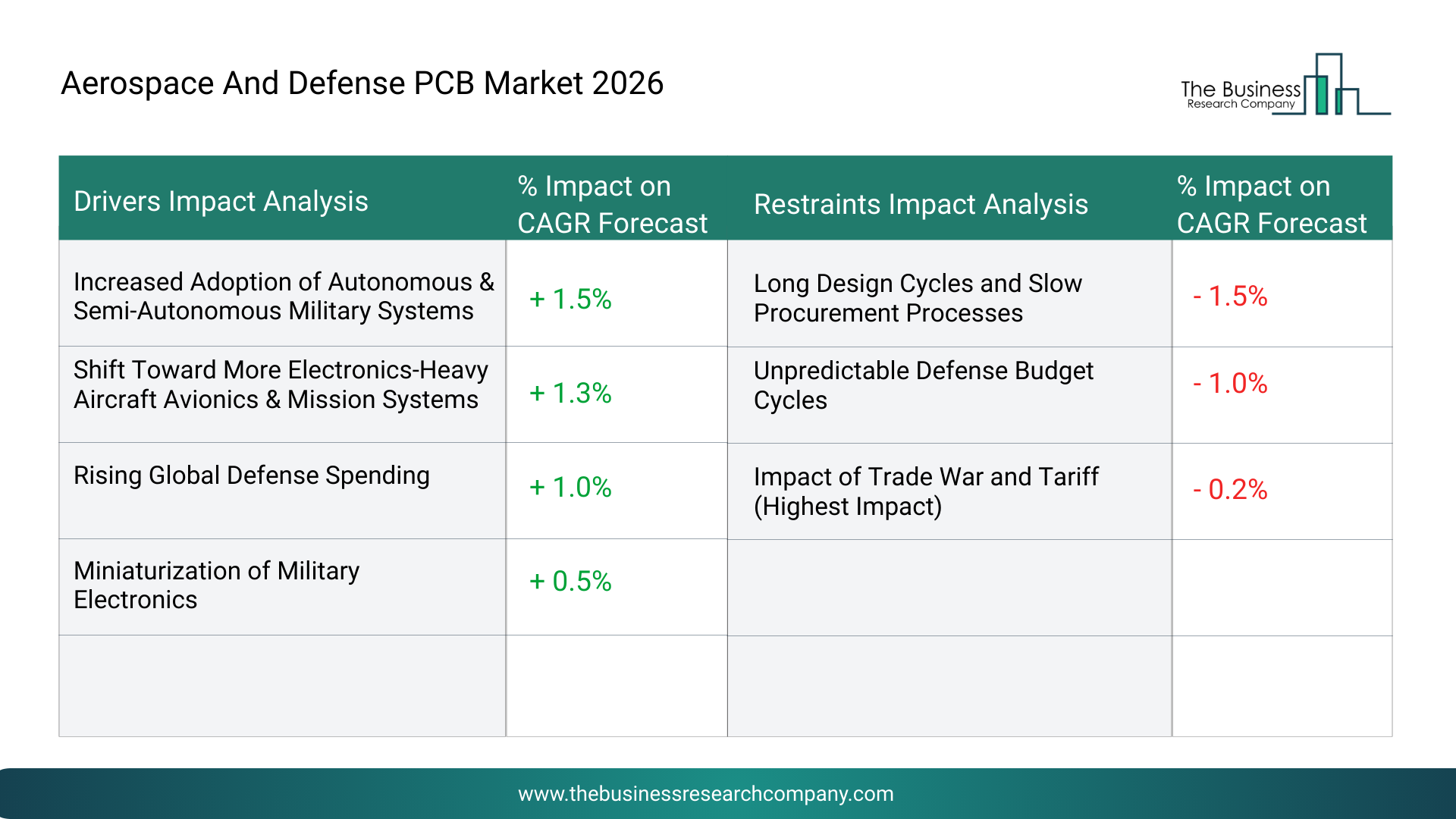
Increased Adoption Of Autonomous And Semi-Autonomous Military Systems- The increased adoption of autonomous and semi-autonomous military systems will become a key driver of growth in the aerospace and defense PCB market by 2030. As defense forces around the world accelerate deployment of unmanned aerial vehicles (UAVs), autonomous drones, robotics platforms and remotely operated weapon systems, demand will rise for high-reliability, high-performance electronic systems, including control units, sensor modules, communication subsystems and mission-critical computing hardware, all of which depend heavily on specialized printed circuit boards. These systems often require multilayer, ruggedized and high-density PCBs that can handle the demands of mobility, shielding, thermal stability, vibration resistance and long-term reliability under field conditions. As procurement of autonomous and semi-autonomous platforms grows, PCB manufacturers are likely to see increasing orders, leading to expanded production capacity and further innovation in defense-grade board technologies. As a result, the increased adoption of autonomous and semi-autonomous military systems is anticipated to contributing to a 1.5% annual growth in the market.
Shift Toward More Electronics-Heavy Aircraft Avionics And Mission Systems - The shift toward more electronics-heavy aircraft avionics and mission systems will emerge as a major factor driving the expansion of the aerospace and defense PCB market by 2030. As aircraft manufacturers increasingly integrate advanced avionics, digital flight controls, onboard communication, navigation systems, sensor arrays and mission-critical electronics into both military and commercial aircraft, there will be rising demand for high-density, high-reliability printed circuit boards to support these complex electronic architectures. These sophisticated avionics and mission systems require multilayer PCBs with high signal integrity, compact design, thermal and vibration resilience and long-term reliability, attributes that only advanced aerospace-grade PCBs can deliver. With aircraft systems becoming ever more electronics-centric, PCB suppliers can expect increasing orders for ruggedized, miniaturized and high-performance board solutions tailored for avionics and mission-critical applications. Consequently, the shift toward more electronics-heavy aircraft avionics and mission systems is projected to contributing to a 1.3% annual growth in the market.
Rising Global Defense Spending -The rising global defense spending efforts as a major factor driving the expansion of the aerospace and defense PCB market by 2030. As governments around the world allocate larger budgets toward strengthening military readiness, upgrading strategic capabilities and expanding procurement of advanced defense systems, demand will increase for high-performance electronic components that rely heavily on specialized printed circuit boards. Higher defense expenditure directly supports the acquisition of modern avionics, surveillance systems, communication platforms, missile technologies and electronic warfare equipment, all of which require multilayer, ruggedized and high-reliability PCBs capable of withstanding thermal stress, electromagnetic exposure and mission-critical operating conditions. With military forces intensifying investments across all major domains, PCB manufacturers are expected to benefit from rising production requirements, expanded procurement cycles and the continuous development of next-generation defense electronics. Therefore, rising global defense spending is expected to drive the growth of the aerospace and defense PCB market during the forecast period. Consequently, rising global defense spending is projected to contributing to a 1.0% annual growth in the market.
Miniaturization Of Military Electronics - The miniaturization of military electronics will emerge as a major factor driving the expansion of the aerospace and defense PCB market by 2030. Modern defense systems increasingly require compact, lightweight and high-performance electronic architectures to support next-generation missions across air, land, sea and space. Miniaturized electronics enable greater payload efficiency, improved mission flexibility and reduced power consumption, all of which are essential for platforms such as small satellites, UAVs, precision-guided munitions and advanced communication systems. Moreover, miniaturization enhances system resilience and allows for modular designs that can be easily upgraded or reconfigured based on mission needs. As military programs continue shifting toward compact, high-density electronics to support evolving defense requirements, the demand for advanced, reliable and space-efficient PCB solutions will increase correspondingly. Consequently, the miniaturization of military electronics is projected to contributing to a 0.8% annual growth in the market.
Access the detailed Aerospace And Defense PCB Market report here:
https://www.thebusinessresearchcompany.com/report/aerospace-and-defense-pcb-global-market-report?utm_source=EINPresswire&utm_medium=Paid&utm_campaign=Mar_PR
What Are The Key Growth Opportunities In The aerospace and defense PCB Market in 2029?
The most significant growth opportunities are anticipated in the military radar systems and advanced aerospace PCB market, the aerospace and defense multilayer PCB Market, the rigid printed circuit boards (PCBs) for aerospace and defense market, and the aerospace, defense and commercial aviation PCB market. Collectively, these segments are projected to contribute over $1 billion in market value by 2030, driven by rising defense modernization programs, increasing deployment of radar and surveillance systems, and growing demand for high-reliability, multilayer, and rigid PCBs capable of operating under extreme environmental conditions. The expansion of next-generation fighter aircraft, unmanned aerial vehicles (UAVs), space platforms, and missile defense systems is accelerating the adoption of advanced PCB technologies with enhanced thermal stability, signal integrity, and miniaturization. This growth underscores the strategic importance of mission-critical electronic infrastructure, fueling sustained investment and technological advancement across the broader aerospace and defense electronics ecosystem.
The military radar systems and advanced aerospace PCB market is projected to grow by $218 million, the aerospace and defense multilayer PCB market by $196 million, the rigid printed circuit boards (PCBs) for aerospace and defense market by $138 million, and the aerospace, defense and commercial aviation PCB market by $136 million over the next five years from 2025 to 2030.
The Business Research Company (www.thebusinessresearchcompany.com) is a leading market intelligence firm renowned for its expertise in company, market, and consumer research. We have published over 17,500 reports across 27 industries and 60+ geographies. Our research is powered by 1,500,000 datasets, extensive secondary research, and exclusive insights from interviews with industry leaders.
We provide continuous and custom research services, offering a range of specialized packages tailored to your needs, including Market Entry Research Package, Competitor Tracking Package, Supplier & Distributor Package and much more
Disclaimer: Please note that the findings, conclusions and recommendations that TBRC Business Research Pvt Ltd delivers are based on information gathered in good faith from both primary and secondary sources, whose accuracy we are not always in a position to guarantee. As such TBRC Business Research Pvt Ltd can accept no liability whatever for actions taken based on any information that may subsequently prove to be incorrect. Analysis and findings included in TBRC reports and presentations are our estimates, opinions and are not intended as statements of fact or investment guidance.
The Business Research Company
Americas +1 310-496-7795
Europe +44 7882 955267
Asia & Others +44 7882 955267 & +91 8897263534
Email: info@tbrc.info
Oliver Guirdham
The Business Research Company
+44 7882 955267
info@tbrc.info
Visit us on social media:
LinkedIn
Facebook
X
Legal Disclaimer:
EIN Presswire provides this news content "as is" without warranty of any kind. We do not accept any responsibility or liability for the accuracy, content, images, videos, licenses, completeness, legality, or reliability of the information contained in this article. If you have any complaints or copyright issues related to this article, kindly contact the author above.
